How x402 Will Change The World
2025-12-02
Note: This article is accompanied by a project writeup of an AI agent built into this site. Check it out here!.
Having been in and out of the crypto ecosystem, I have watched a few core technologies come onto the scene that revitalize my interest in the industry. This is one of those times. x402 is a revival of a defined but long-unimplemented HTTP 402 “Payment Required” standard, poised to bring payments directly into the heart of the internet.
A long, long time ago
Before ERC721 enabled the NFT hype cycle, before ERC20s supercharged DeFi, before we even had Ethereum or even Bitcoin, HTTP was built as the backbone of the internet. With a standard set of protocols, we can confidently build against APIs and websites to send and retrieve data. Behind the scenes of nearly every app and website you use every day, there are hundreds or even thousands of HTTP requests. Most people are familiar with the status code 404, "Not Found". There are actually hundreds of different status numbers that can be returned. In fact, just reading this page means you would have had at least one 200 (success) response handled in the background.
But what is it?
This article is about one of those status codes: 402. The 402 status code has been around since the early days of HTTP, and if you visit the standard page, you will see it reserved for future use. It seems that day has finally come. Coinbase has been pioneering this new standard with their x402 open-source project. Within it, there are a few packages designed to help integrate the 402 error code payment handling seamlessly into your application.
How does it work?
There are two sides to implementing a 402 payment gateway: Buyer and Seller. The seller side implements an API route that requires a specific HTTP header containing a signed payment response, as defined by the x402 spec. Typically, this is done by first hitting the route endpoint and receiving a 402 response which includes a standard structure with information on how to complete the payment request. The library catches this error and automatically submits the signed transaction back to the seller to complete the payment.
 Courtesy of Coinbase's x402 documentation.
Why should I care?
The simplicity of the protocol is why it is poised to be a major building block for the future of the web. APIs can now lock content and data behind payment directly without needing to rely on a centralized payment gateway to manage sessions or accounts. Pay-as-you-go billing is now possible with a simple API call.
Age of the agent
With agentic workflows gaining popularity, agents with embedded wallets can pay the seller for content directly in the request. This is a powerful new use case for the internet, decreasing friction for autonomous transactions. A user could spin up an agent with a specific task, and the agent is now empowered to find, pay for, and deliver the content requested from third parties.
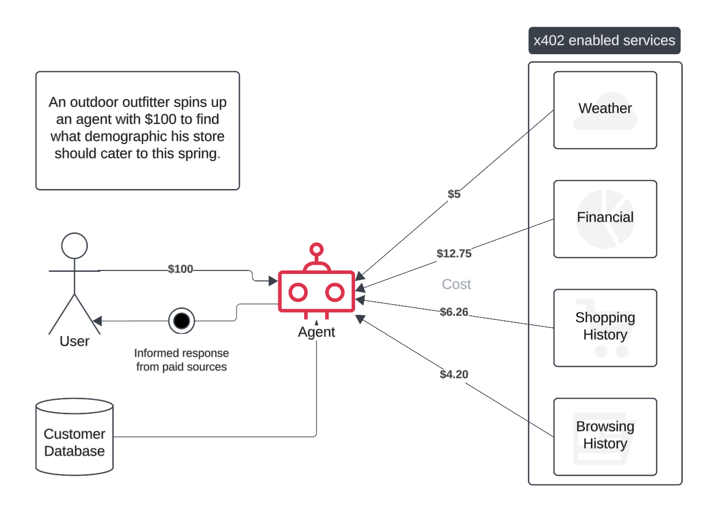
For a specific example, imagine a small-town outdoor outfitter with limited information and technical capability outside a local database of their customers and the ability to spin up an AI agent. In plain language, they may ask the agent to find which customer demographic to target this spring.
The agent then discovers services related to the request. It might pull local weather data for the spring to understand which activities are popular at different temperatures in the area. It could query customer data from data brokers like financial information or search history tied to outdoor activities that are already popular locally. The agent pays for this premium data on its own and then delivers the distilled insight back to the shop owner. This is similar in spirit to how data brokers and ad-tech platforms target demographics for advertising. The difference is the ability for an agent to be instructed in plain language to gather and pay for information to best inform the requester. As the number of these types of interactions grows, the network of agents and application services becomes extremely robust.
The opportunity
Right now, x402 is in its infancy, and the tooling and resources around it are slim, growing, but still very much a small subset of the internet. If the popularity of the protocol continues, and developers start implementing payment workflows into their API endpoints, then we will see a boom in the number of transactions onchain. New data services will rise. New agent orchestration methods will find and rate data quality.
If you're building APIs, now might be the perfect time to start experimenting with x402-enabled endpoints, particularly for premium data or agent-facing services. Even if you're not ready to implement it today, it's worth considering which parts of your API could benefit from a pay-per-call model.
We may not have even seen the most robust use case of this new technological advancement. This simple framework may be on its way to being crypto's biggest use case to date.